


Leadership for Modern Humans
THE LEADERSHIP GAP
People have changed faster than leadership has.
Technology has accelerated. Work has changed. Expectations have evolved. The way people connect, communicate, learn, and make decisions has fundamentally shifted. Attention is fractured, information is constant, and trust is harder to earn.
Yet many leadership approaches were designed for a different era—when communication moved in one direction, authority created automatic credibility, and leaders could manage the message without being challenged by the lived experience of their people.
That world no longer exists.
Organizations still need commitment, ownership, adaptability, collaboration, and performance. But modern humans are more likely to contribute at their highest level when they experience trust, connection, voice, purpose, and a sense that their humanity matters.
Leadership for Modern Humans exists to close that gap—not by lowering expectations, but by equipping leaders to create the human conditions that inspire people to meet them.
Closing the gap between what organizations need from their people and what people now need from work.
THE LEADERSHIP GAP
77% of employers believe employees feel trusted and empowered by leadership. Only 57% of employees agree.
Source: EY Work Reimagined Survey


WHAT MODERN HUMANS NEED
Modern Humans Need More Than Information
Modern humans are surrounded by more information than any generation before them. Information still matters—but information alone rarely creates trust, commitment, or behavior change. People need leadership that cuts through the noise and creates something real.
Attention must be earned. Trust must be demonstrated. Connection must be intentional. People need to understand what is expected of them, why it matters, and how they contribute.
This is why leadership can no longer be measured only by how effectively a message was delivered. It must be measured by what people experience because of it: Do they feel clearer or more confused? More connected or more isolated? More capable of moving forward or more reluctant to engage?
Leaders are no longer in the information business. They’re in the experience business.
Information informs. Experiences transform.
THE NEEDS GAP
Only 16% of employees say their most recent conversation with their manager was extremely meaningful.
Source: Gallup

WHAT THIS WORK SOLVES
Most organizations do not have an information problem. Their people have heard the strategy, seen the values, attended the training, and read the messages. The challenge is turning that information into something people trust, remember, and act upon.
Leadership for Modern Humans helps organizations:
• Rebuild trust when words and actions have separated
• Recapture attention in a world of constant distraction
• Create clarity and confidence during change
• Strengthen connection and belonging
• Turn stated values into everyday behavior
• Build accountability, adaptability, and momentum
These challenges often appear as disengagement, resistance, poor communication, cultural friction, or stalled performance. But beneath those symptoms is the same fundamental gap: organizations need people to engage, adapt, take ownership, and perform—while modern humans need trust, connection, voice, and purpose to contribute at their highest level.
Leadership for Modern Humans equips leaders to understand both sides of that equation and create the conditions where organizational expectations and human needs can work together.
When the human experience changes, organizational performance follows.
The Human Problems Behind Organizational Performance
THE HUMAN COST BECOMES A BUSINESS COST
Only 20% of employees worldwide are engaged—costing the global economy an estimated $10 trillion in lost productivity.


THE FRAMEWORK
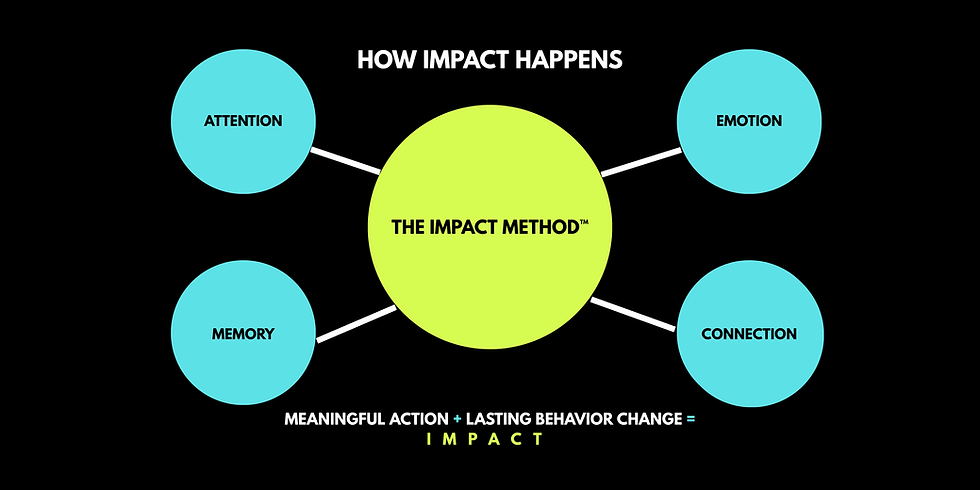
Impact is not accidental. It is created through intentional experiences that capture attention, generate emotion, strengthen memory, deepen connection, and move people toward meaningful action.
Attention opens the door. Emotion gives the message meaning. Memory allows it to endure. Connection makes it personal. When these forces work together, information becomes an experience—and that experience becomes far more likely to influence behavior.
Jen developed The Impact Method™ to give leaders a practical way to close the gap. By understanding how attention, emotion, memory, and connection influence behavior, leaders can communicate more effectively, build trust, strengthen culture, and inspire meaningful action.
Impact isn’t created by information. It’s created through experience.
The Impact Method™
ATTENTION CAN NO LONGER BE ASSUMED.
Employees are interrupted by a meeting, email, or chat every two minutes during the workday.
Source: Microsoft Work Trend Index
FROM PHILOSOPHY TO EXPERIENCE
Leadership for Modern Humans in Action
Her keynotes bring The Impact Method™ to life through neuroscience, music, humor, nostalgia, movement, storytelling, and full audience participation. People don’t simply hear about attention, emotion, memory, and connection—they experience those forces working around them in real time.
The result is a full-throttle, concert-style leadership experience designed to capture attention, create shared emotion, strengthen connection, and make the message impossible to forget.
Modern humans don’t change because they know more.
They change because they experience something.
PEOPLE ARE SURROUNDED BY COMMUNICATION—AND STILL FEEL ALONE.
One in five employees worldwide experiences loneliness at work on a daily basis.
Source: Gallup


THE FUTURE OF LEADERSHIP
The future of leadership will not be defined by how much leaders know, how carefully they control the message, or how convincingly they perform certainty. It will be defined by their ability to earn attention, build trust, create connection, and turn intention into an experience people can believe.
Technology will continue to accelerate. Expectations will continue to rise. The organizations that thrive will be led by people who remain deeply human through it all—leaders willing to listen, adapt, tell the truth, and understand the impact they create.
Modern Humans Require Modern Leadership
AUTHORITY NO LONGER GUARANTEES CREDIBILITY.
Only 29% of leaders trust their immediate manager—and just 32% trust their organization’s senior leaders.
People have changed faster than leadership has.
It’s time leadership caught up.
That’s why we need Leadership for Modern Humans.